
Medianews.az is owned by the Member of the Milli Majlis, Chairman of the Eurasian Migration Initiatives Platform Public Union, Azər Allahverənov.
- Mr. Azər, as in every country, some citizens in Azerbaijan also go abroad to work. Which countries do Azerbaijanis mostly choose for this purpose?
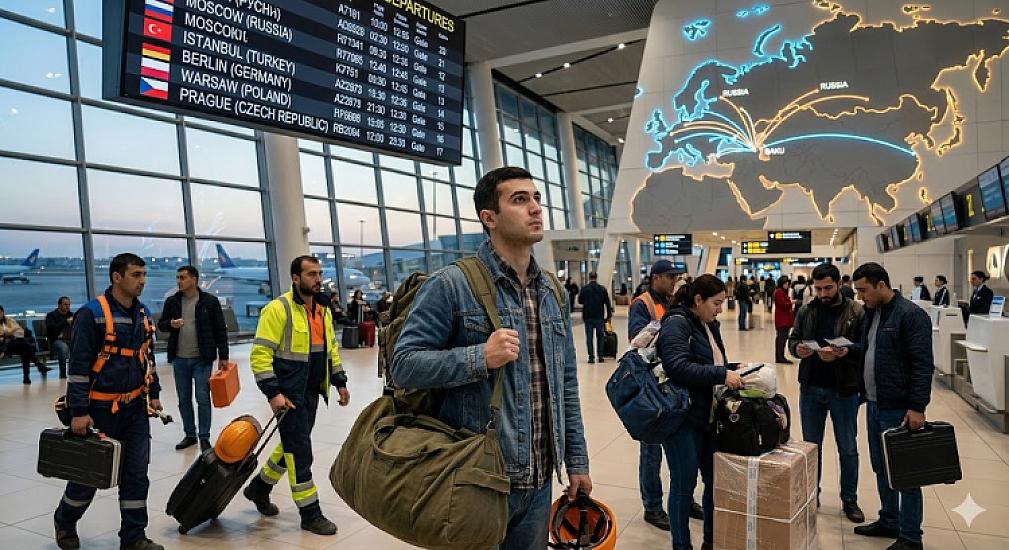
- We must specifically mention three countries in Azerbaijan's migration exchange with neighboring countries: Russia, Turkey, and Georgia. Azerbaijan's migration exchange with these countries is quite intensive.
Naturally, where migration exchange is intensive, the number of our citizens engaged in labor activity is also high. That is, the names of countries involved in migration exchange correspond to where Azerbaijani citizens mostly work, namely Russia, Turkey, and Georgia. The countries ranking fourth and fifth vary from time to time, even in certain seasons of the year. The top three consisting of Russia, Turkey, and Georgia remain stable.
The largest number of migrants falls to Russia. Approximately 80-85 percent of Azerbaijani migrants are in this country. A significant portion of them is engaged in labor activity. Previously, various figures were cited about the number of Azerbaijani migrants in Russia. Currently, it is estimated that about 450-500 thousand of our citizens live there. Not all of them are engaged in labor activity since some are family members of working migrants. Most of these family members do not work.
Based on official sources, I can say that the number of Azerbaijani citizens engaged in labor activity in Russia is slightly over 120 thousand. This information relates to individuals with work permits. However, in unofficial sources, there is information suggesting more people are engaged in labor activity. It is also important to mention allegations that some migrants work illegally. This situation was more pronounced before. Now, a different system has been established in Russia concerning migration. The state exerts strict control over migrants' entrance to the country. This prevents migrants from residing illegally in Russia and engaging in semi-legal labor activity to some extent. Yet, this does not mean those migrants completely disappear. Even today, some individuals live illegally and work in Russia. Such cases arise due to various objective and subjective reasons.
- Have there been any different trends or changes observed in labor migration in recent years?
- Overall trends in labor migration do not change much. It is true that recently European countries attract more migrants. For example, we observe an increase in the number of Azerbaijanis who want to work in countries like Poland and the Czech Republic. It can also be noted that Scandinavian countries and Germany are among the destinations where our labor migrants go considerably.

- Which age groups in Azerbaijan mostly prefer to work abroad?
- The profile of labor migrants in terms of age groups does not change much. Migration is mostly represented by people aged 20-55, which corresponds to the working-age population. They prefer to work abroad and mostly remain as labor migrants in the countries they go to.
- What can you say about the impact of labor migration on the economies of both the country where the migrant works and the migrant's home country?
- Labor migration has significant economic impacts in both respects. For example, when a labor migrant operates in a foreign country, they pay taxes, rent housing, and incur other expenses there. This means that a large portion of the money they earn is spent in various sectors of that country, providing substantial economic benefits to the state. There are countries that can gain much more from labor migration. Even if they do not fully rely on migrants for their economy, they are very interested in encouraging migration flows in different forms. Canada can be cited as an example. Even during periods of tension in migration processes, Canada has declared interest in accepting many migrants. This is one side of the matter.
On the other hand, a labor migrant working in another country can also provide substantial benefits to their own country. For instance, among Central Asian republics, Tajikistan and Uzbekistan stand out. Particularly, the funds from migrants working in Russia hold a significant share of Tajikistan’s GDP. We can also say that Uzbek migrants provide considerable support to their home country.
Azerbaijani citizens working in Russia and other countries primarily support their families living back home through remittances. The family members residing in Azerbaijan solve many issues precisely due to migrants' money inflows. However, we also observe reductions in transferred funds during periods when migration exchanges are weak. For example, there was a time when more than 1 billion US dollars were sent from Russia to Azerbaijan annually. Now, this amount is several times lower. Different sources report that the officially and unofficially sent amounts vary between 200-400 million dollars. In any case, this is still a certain capital flow into the country.
It is also worth mentioning that migrants may acquire some technologies abroad and later come back to apply these technologies here. This is one of the beneficial aspects. It is true that this is not widely developed yet. However, it contributes somewhat to the country's economy, especially to the employment sector, and there are some positive examples in this direction.
Nailə Qasımova,
Medianews.az