
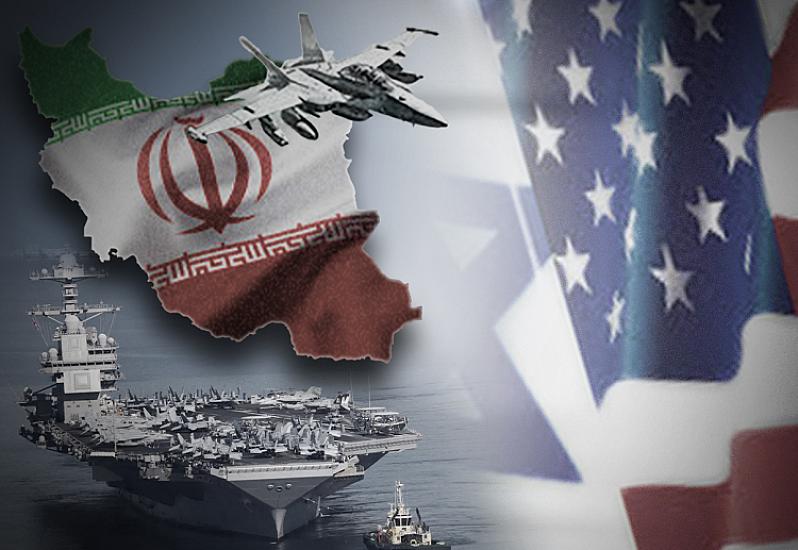
In the context of the US/Israeli duo's aggression against Iran, Iran's defensive battles and, in some cases, offensive operations have led to the current ceasefire.
Since the beginning of the war, I have been writing that Iran would expand and diversify the geography of the battles. As I noted in previous articles, if Iran had not expanded the scale of the war to this extent, it would have faced defeat. US officials also admit that Iran's attacks on the Gulf countries were unexpected for them. Why did I have this conviction? Properly looking at the maps says it all: Iran was surrounded by US military bases on all sides. If Iran had not struck the Gulf countries, those bases would have maintained the speed and tempo of the attack.
In wars, time is the most important factor. If the Gulf countries had not been hit, US aircraft would not lose time refueling in the air. The long distance is not only a loss of time but also a significant factor affecting the payload carried by combat aircraft. For example, there is a big difference between fully loading a plane with missiles and bombs and operating with less load while considering fuel consumption.
On the other hand, it becomes clear that Iran sent more than 100 soldiers to Lebanon to reorganize Hezbollah. This operation was carried out so secretly that information only began to emerge after the 10th day of the war. Many thought Hezbollah was finished, but Iran had prepared it for combat in a completely different form. In this war, Iran coordinated with Hezbollah and the Houthis to strike Israel several times with devastating blows. Although writing and talking about this is easy, its execution is a process that requires extremely serious preparation, strategic intelligence, and great effort.
Before the war, I repeatedly noted that if military operations began, Iran would close the Hormuz Strait. Many criticized this forecast at the time. However, Iran did everything that was said to be "impossible," one by one. Especially some experts in Azerbaijan claimed that Iran's missiles were fired "randomly." In reality, this was a very simplistic and meaningless approach. Because if Iran had not struck the US radars in the Gulf and Jordan, ballistic missile tracking systems, it would have achieved no results. Since Iran destroyed these systems, Israel was forced to attempt to neutralize all missiles and drones only within its own airspace.
One of the main factors strengthening Iran's hand was the Houthis. The Houthis did not limit themselves to striking Israel; they also neutralized Saudi Arabia, kept the Red Sea under threat, and warned they would close the Bab al-Mandeb Strait. Imagine: Along with the Hormuz, the Bab al-Mandeb Strait is also being closed. This meant that the US had to consider not only an attack on Iran but also several strategic directions simultaneously. The root of Trump's aggressive and hysterical statements like "I will destroy civilization," "I will bring Iran back to the Stone Age" was precisely this deadlock.
During the war, although the US and Israeli duo struck Iran, after a while, Trump admitted that "there is nothing left to hit in Iran." The only remaining targets for them were civilian infrastructure and nuclear centers, and striking these would have provoked a very harsh response from Iran. Striking all the oil and gas fields in the Gulf would not only paralyze the global economy but also force the Arabs to get off their expensive cars and ride camels again. Of course, the US and Israel had at least tactical nuclear bomb options. Could they have used them? Yes! You can expect anything from radical religious people. The more radical the Iranians are, those under US and Israeli control are no less so.
Did Iran have weak points? Undoubtedly. There are significant gaps in air defense, especially. These systems are vital for any country conducting defensive battles. However, the fact that the war ended under current conditions suggests that Iran made far more correct moves than mistakes.
Regarding the Iranian population's support for the government, it is not right to explain this solely by ideology. First of all, trying to teach the people of that geography how to fight is at least shameful. On the other hand, the people believe that if victory is won, the government will share this success with them. For example, nearly all current leaders are veterans of the Iran-Iraq war.
So who is the winner of this war? Looking at the results: the main goal of the US and Israel was to change the regime in Iran, but they did not succeed. There was no real result regarding the nuclear program either; the "control" issues in the announced agreements existed before the war as well. The ballistic missile program was not even a subject of discussion.
Although some tactical objectives set at the beginning of the war were achieved, this did not change the strategic outcome. For example, the supreme religious leader was aged, gained the status of a "martyr" because he was "killed" in the war, and his son, who succeeded him, was recognized as a "veteran" because he was wounded in battle. Although many generals were killed, those who replaced them continued the war at the same pace.
Strategically, the main winner of the war was Pakistan. Although Turkey made many attempts to stop the war, the official statements of Islamabad were considered more decisive and credible. The other winner was Iraq. Iran's strikes on military bases in Iraqi territory essentially "freed Iraq's hands and feet."
The biggest losers of the war were the Gulf countries. They will not only reconsider their security umbrella but also always take Iran's dictate into account. Another loser was Israel; under current conditions, the "Greater Israel" state plan has failed.
We are located in a very interesting geography. The dreams of those who talk big and make gigantic plans always fail on this land. In general, this geography is a cemetery of great dreams. If those on this side of the Aras River threw stones at the root of the "Greater Armenia" delusion, then those on the other side of the Aras did the same to the current conditions of "Greater Israel," it would not be a mistake to say...
Səxavət Məmməd