
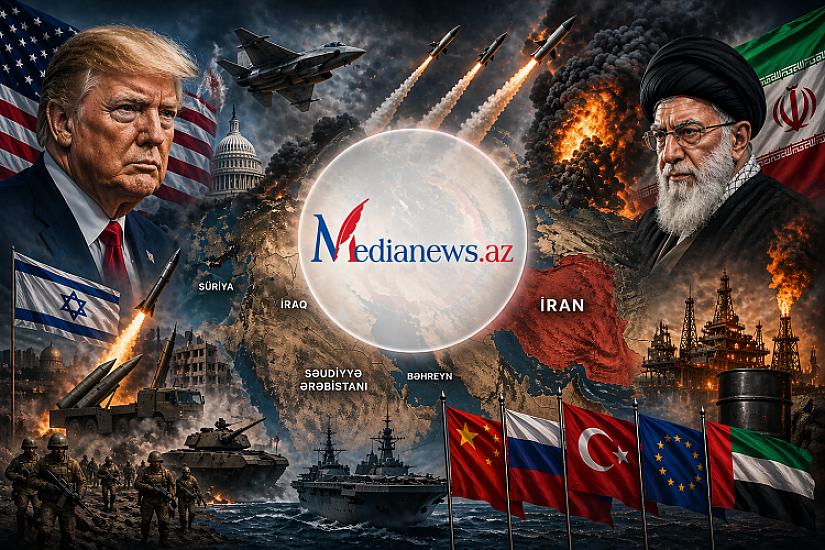
The war initiated by the US and Israel with Iran is currently experiencing a fragile ceasefire period.
There are many political reasons for the ceasefire to be achieved, but militarily this pause was inevitable. Because the US approached the process short-term. Later, the US president and several officials stated that the operation was planned for a duration of 4-6 weeks. This is not a random number; when preparing for any operation, the means to be used there and their number are definitely taken into account. In other words, the US could continue the fighting only as long as the resources it allocated to the operation in Iran allowed. It was clearly written in the US media that resources were running out. Even Trump admitted a few days ago that the ceasefire was a means for renewed preparation.
During the 40-day war, the US considerably depleted its reserves. It is noted in the US media that 45% of precision strike missiles, half of the missiles of the THAAD air defense systems, about 50% of the "Patriot" missiles, and 30% of the "Tomahawk" cruise missiles were used in the battles. Again, the US media, citing intelligence agencies, write that Iran still holds 60% of missile launchers, and damaged ones have been repaired quickly. In addition, more than half of the drone reserves remain, which, considering the production process, represents a significant military resource.
While conducting negotiations during the ceasefire, the parties are seriously engaged in gathering resources. Iran, through third countries, acquires new weapons from China, and directly from Russia, particularly portable systems designed to destroy low-flying air targets. The 40-day war demonstrated that Iran’s only weak point is not just air defense systems but also a shortage of portable surface-to-air missile complexes. If Iran obtains many of these types of missiles, the situation in the air could change significantly. Moreover, Iran might also supply these missiles to the groups in Iraq, which would turn into a real problem for aerial refueling planes.
During the course of the war, the US demanded "Patriot" missiles from South Korea and its European allies. Currently, the US is carrying out similar procurement from Japan. None of the parties in the field has been able to gain absolute superiority, making the situation at the negotiation table extremely tense. Because the conditions are very difficult, a quick agreement is not expected. The US has blockaded Iran, and Iran has closed the Strait of Hormuz. True, the US claims that only Iran suffers from this, but the fact is that all the Gulf countries suffer from this situation. Furthermore, the US blockade is not impenetrable either. Western media have reported that more than 30 Iranian tankers have evaded the blockade. Actually, it is not convincing that the blockade is impenetrable, because the area is much broader than Venezuela’s blockade. Also, I want to mention that Iran has taken a strategically correct step by imposing a numerical limit on the passage of tankers in the Gulf after the ceasefire. Because there is a difference between the Gulf being completely empty and having tankers there; with this, Iran keeps an important leverage and threat tool in its hands.
Trump says that strikes will be carried out on railways, bridges, and power plants in Iran, which are in fact civilian objects. Iran officially declares that in such a case, it will hit all oil and gas fields in the Gulf. Currently, there is a serious increase in the price of gasoline and gas worldwide. The situation has even reached such an extent that some airlines have canceled flights. For example, Germany's "Lufthansa" airline (Lufthansa Group) officially announced the cancelation of 20,000 flights for the summer season of 2026. The reason is the sharp rise in the price of aircraft fuel (kerosene) and the doubling of fuel costs amid the conflict in the Middle East. Thus, the so-called blow Trump dealt to Iran is actually a blow dealt to the entire world economy. If Iran hits the oil and gas fields in the Gulf, the situation will become even more complicated.
Undoubtedly, what is happening benefits Russia. True, Ukraine has struck Russia's oil refining plants, but the "Druzhba" oil pipeline had to be opened. If the situation deepens further, some partners in Europe will ignore Ukraine, which is already being used up...
Sometimes when events occur, it is impossible to accurately evaluate them, and one has to wait for the next event. The reason why there was no reaction to the calls by the US and Israel during the war for people in Iran to rise up is precisely the protests in January and the harsh measures taken by the authorities against the demonstrators at that time. Trump now states that 43,000 people were killed in Iran during the protests. What worries and angers Trump is not the number of people killed. If those people had not been killed, they could have risen during the war and chaos would have erupted internally. In general, I am far from thinking that any US president or leader of an imperialist country cares about humanity. In fact, genocide was committed in Gaza right before the whole world's eyes, and supposedly Trump, who claims to care about humanity, proposed to deport the Palestinians from there and turn Gaza into a tourism zone. A lesson on humanity...
If the war restarts or ends under these conditions, it will not mean that waters will calm down in the Gulf. Iran has long been active in Bahrain. Serious processes within Bahrain, even a confrontation between the authorities and the people, seem inevitable. Additionally, steps will be taken towards the United Arab Emirates. I should also add that if the war flares up again, the geography of the battles will expand, and additional countries will join the process.
Sehavet Mammad