
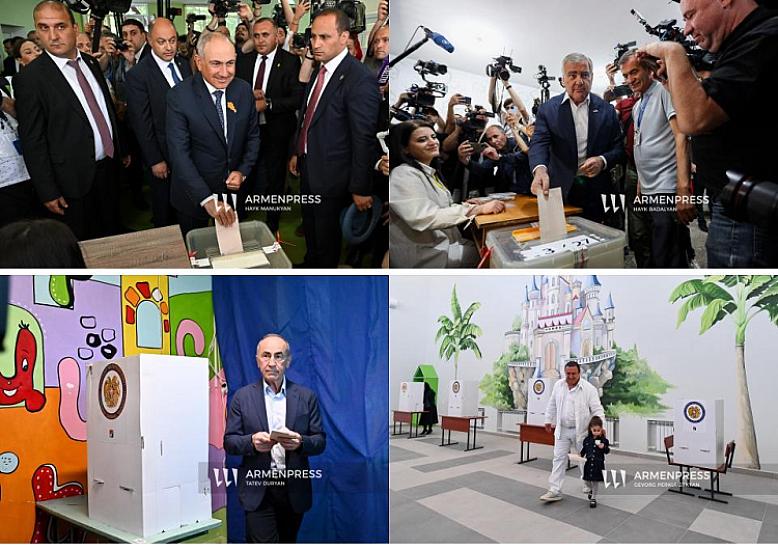
According to the preliminary results of the parliamentary election held in Armenia on June 7, among the 18 competing forces, four contenders stand out. Prime Minister Nikol Pashinyan's Civil Contract Party received 49.82 percent, the Strong Armenia bloc 23.28 percent, the Armenia bloc 9.93 percent, and the Blooming Armenia Party 3.99 percent of the votes.
To enter the parliament formed by a proportional system, parties must gather 4 percent of valid votes, while blocs must gather 8 percent.
Thus, as a result of the current election, three forces are officially recognized as opponents to Pashinyan's government: the Strong Armenia bloc, the Armenia bloc, and the Blooming Armenia Party. It has been confirmed that the first two will receive mandates.
The leading force in the Strong Armenia bloc is the Strong Armenia Party led by Samvel Karapetyan. Born in 1965, Samvel Karapetyan is a businessman operating in Russia. He was arrested in June 2025 on charges of calling for a violent takeover of power and was released to house arrest in December. The Strong Armenia Party was founded in January 2026.
Robert Kocharyan heads the candidate list of the Armenia bloc. Born in 1954, Robert Kocharyan was the leader of the occupying regime in Azerbaijan's Karabakh region from 1992 to 1997. In March 1997, he became the Prime Minister of Armenia. In February 1998, President Levon Ter-Petrosyan resigned. Starting to exercise presidential powers as Prime Minister, Robert Kocharyan was elected head of state in 1998 and 2003.
The leader of the Blooming Armenia Party candidates list is Gagik Sarukyan. Born in 1956, Gagik Sarukyan is a businessman. He founded the Blooming Armenia Party in 2004 and was elected as a member of parliament in 2003, 2007, 2012, 2017, and 2018.
Nikol Pashinyan calls these three forces a "three-headed war party."
Is the opposition to Pashinyan's government, so to speak, the “three-headed war party,” capable of causing problems in the peace process with Azerbaijan? Does the opposition have the power to disrupt or delay processes such as the signing of a peace agreement, changes to the Armenian Constitution, removal of references containing territorial claims to Azerbaijan and Turkey from the constitution, and the opening of the Zangezur corridor?
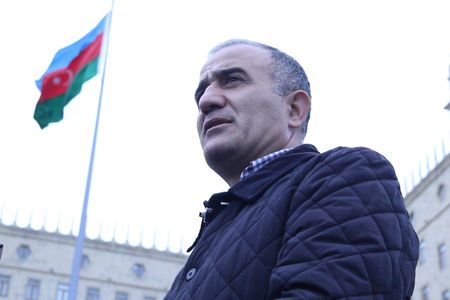
Regarding this issue, Medianews.az editor and political analyst Ogtay Gasimov stated that the competition in the elections in Armenia was, roughly speaking, between the Western-oriented and Russian-oriented groups: “As in Moldova, the Russian-oriented groups were defeated in Armenia as well. It was expected that Nikol Pashinyan would win these elections because polls showed his higher rating. But the discussion was about whether the election results would enable Pashinyan to form a government alone or not. That was the main question. Initial results showed that Pashinyan has gained this opportunity and is capable of forming a government single-handedly.
Russia had two main objectives in these elections. The first was to have Pashinyan lose, bringing pro-Russian forces to power to preserve their influence in Armenia. However, they understood in Russia as well that making Pashinyan lose would be difficult. For example, Putin's recent phone call to Pashinyan congratulating him on his birthday and other statements indicate that Russia is actually preparing for the second scenario. The second scenario was that Russia's supporters would gain as many seats as possible in parliament. I believe that Russia achieved its goal in this regard."
O. Gasimov noted that while Pashinyan received 54 percent of the vote in the 2021 parliamentary elections, he won 50 percent in the current elections, meaning he lost 4 percent of the vote compared to the previous election: “This means Pashinyan lost 10 seats in parliament. Secondly, pro-Russian forces were represented in parliament with 26.4 percent in the previous elections, but now they have increased this to 37 percent. If previously they held 27 seats, this time they will hold 44 seats. Russia will try to exert as much pressure as possible on Armenia through this. Of course, Pashinyan’s job will not be easy. Especially regarding constitutional changes and similar crucial steps, pro-Russian forces will try to hinder Pashinyan.
However, Pashinyan’s hand is stronger in matters like opening the Zangezur corridor, border delimitation and demarcation, and other similar issues. Since these are technical processes, he can carry them out rapidly. The referendum on constitutional changes is a bit more complicated. Pashinyan can potentially manipulate the situation to some extent. He might use internal pressures as an excuse to delay the referendum somewhat. This is unlikely but possible. Still, Pashinyan is calling for the adoption of a new constitution. Depending on the circumstances, he has the means to achieve this. We hope he will fulfill his promise and ensure the referendum is held and receives a positive result by the end of the year.”
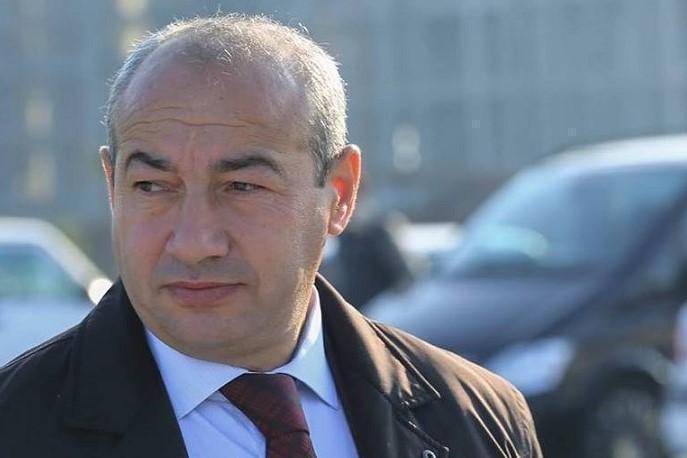
Political analyst Khagani Jafarli Medianews.az said that the conflict between Armenia and Azerbaijan was not the result of the will of the Armenian and Azerbaijani peoples: “Therefore, the opposition that Pashinyan calls the "three-headed war party" is not, in itself, capable of obstructing the peace process. The war party in Armenia is strong only as long as Russia is strong. Russia is weakening and collapsing day by day. Therefore, the opposition that Pashinyan calls the "three-headed war party" will not be able to cause problems in the peace process with Azerbaijan.
Regarding changing the Armenian Constitution and removing references containing territorial claims, it appears that some time is needed. As for the Zangezur corridor (TRIPP), the opening of the corridor can be considered a technical issue. Once technical matters are resolved, the opening of this route will happen. Russia’s weakening and the strengthening of the US in the South Caucasus will make TRIPP inevitable.
Overall, Russia’s weakening and the US’s strengthening in the South Caucasus and Central Asia will ensure permanent peace and cooperation in the region. Those trying to obstruct this process will eventually be forced to leave the stage.”
Nailə Gasimova,
Medianews.az