
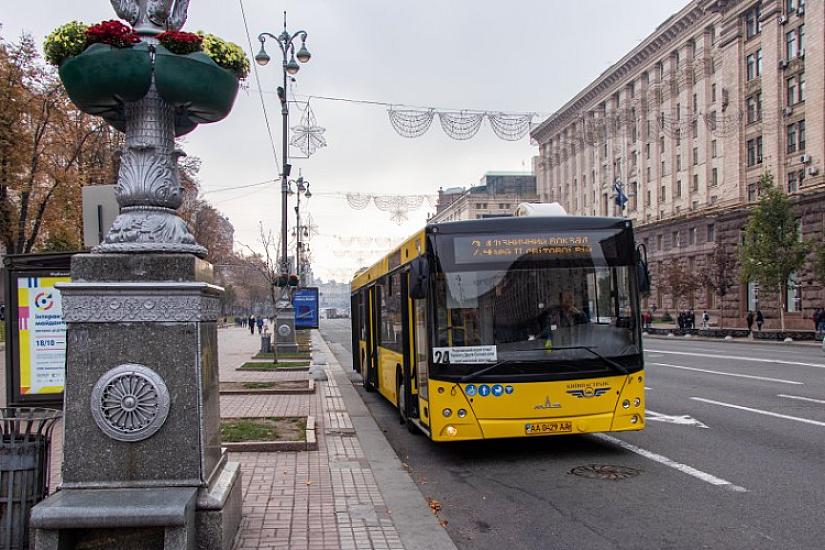
The Kyiv city council had promised that tariffs would not change until the martial law ends. Nevertheless, the city council has brought up the issue. Currently, the fare remains at 8 hryvnia (0.31 AZN), but the city mayor Vitali Klitschko has already tasked preparing new tariff calculations based on economic justification.
Why should the tariff be increased?
The problem in Kyiv is simple: current tariffs do not cover the real costs. In European cities, public transport is considered a social service and the passenger pays only part of the costs. The remainder is subsidized by the municipality. This ratio usually ranges from 30% to 70%.
In Ukraine, on the other hand, there is a hybrid model:
Municipal transport – subsidized, private routes – operate on market principles.
This leads to fragmentation and inefficiency of the system.
What could the tariff be?
According to current estimates:
Cost of transporting 1 passenger: ~40+ hryvnia (1.57 AZN)
Possible new tariff: 20–25 hryvnia (0.78-0.98 AZN)
This means a more balanced distribution of costs between the passenger and the budget. Cities like Ternopil, Ivano-Frankivsk, and Lviv are already moving in this direction.
For example, such a model is being discussed in Lviv:
With electronic card: 23 hryvnia (0.90 AZN)
With bank card: 26 hryvnia (1.02 AZN)
Cash: 30 hryvnia (1.17 AZN).
Moreover, free transfers are also being reinstated – which means the passenger gets more value.
The problem is not only the tariff
The main issue is often forgotten: passenger flow and route planning.
In 2016, the World Bank had proposed route optimization for Kyiv and this had the potential to reduce costs by 13%.
Since then, the city has grown, but the route network has not adapted at the same pace.
The result is: empty routes, congested lines, inefficient costs.
Therefore, a tariff increase in Kyiv seems inevitable. But the main question is: Will this only be a price increase, or will it come together with system reform?
If routes are optimized, schedules updated, and a transfer system implemented, then even a higher fare can appear more fair and reasonable for the passenger.
Otherwise, it will just mean a more expensive, but equally inefficient system.
Rauf Agamirzayev,
expert on transport issues