
Russian investigators have reopened the case concerning the death of a 65-year-old man after drinking a glass of "Jermuk" mineral water. This was reported to Lenta.ru by the Investigative Committee of the Republic of North Ossetia-Alania, Russia.
The case involves a criminal investigation under Part 2 of Article 238 of the Russian Criminal Code ("Provision of services that do not meet safety requirements for the life or health of consumers, resulting in the death of a person due to negligence"). It is reported that the investigation was reopened in March 2026 due to newly discovered circumstances.
"On February 11, 2024, the victim consumed 'Jermuk' mineral water purchased from a retail outlet in Vladikavkaz. Afterwards, he felt unwell and his condition deteriorated. He was hospitalized, but despite urgent medical care, doctors could not save him," the publication states.

Our attentive readers probably remember that we wrote about this topic last year. In January of last year, it was reported that the family of Vladikavkaz businessman Oleg Gusev, who was poisoned by "Jermuk" (Istisu in Western Azerbaijan - editor) mineral water, filed a claim worth 1.5 billion rubles against the domestic producer. At that time, Russia's other famous publication "Kommersant" also wrote on the matter. It was reported that in February 2024, a resident of Vladikavkaz suffered burns in the esophagus after drinking "Jermuk" mineral water and later died in hospital.
The puzzling part of the matter is that instead of mineral water, there was... vinegar in the bottle. It is very interesting how the bottles of "Jermuk," which plays an important role in Armenia’s exports, ended up containing vinegar, who transported it to Russia. At that time, "Rospotrebnadzor" halted the sale of certain batches of "Jermuk" as part of safety measures. Additionally, a compensation lawsuit demanding 1.5 billion rubles was filed against the Armenian company producing "Jermuk" mineral water, "Jermuk Group" JSC, its representatives in the Russian Federation, and its distributor. Furthermore, the claim "Regarding Compensation for Damages" was filed by Oleg Gusev’s widow and two daughters at the Soviet District Court of Vladikavkaz.
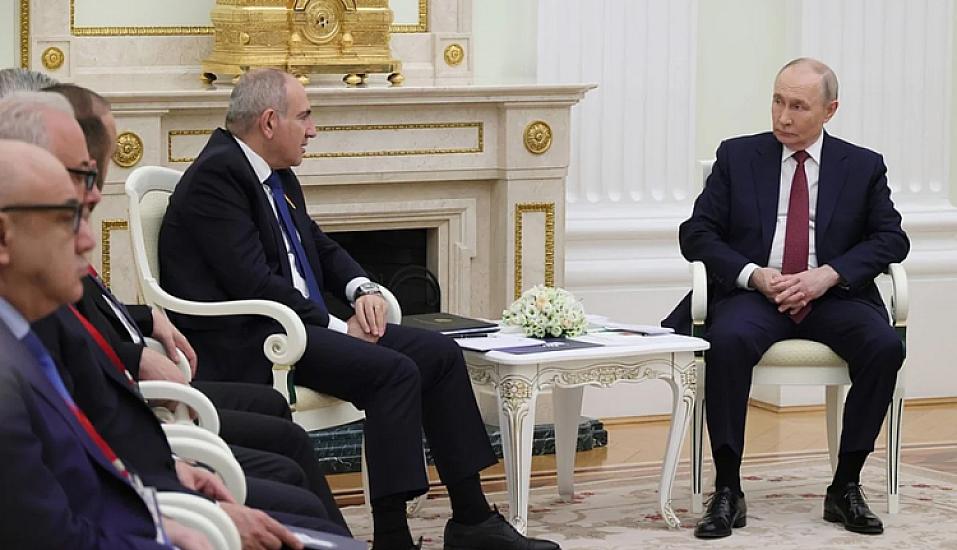
More than a year has passed since then, and now the issue of "one bottle of vinegar" has been raised again. Is this a coincidence? Definitely not. Moreover, it cannot be considered accidental that the topic of a Russian citizen who died from poisoning after drinking Jermuk water was "revived" amid the Armenian parliamentary elections and at a time when relations with Russia have entered a tense phase. It is true that the official information states the investigation was renewed before the intense Vladimir Putin – Nikol Pashinyan meeting. But if so, why was this not announced in March? On the other hand, even if the claim is true, it itself serves as pressure on the Armenian leadership.

What does Russia want from Armenia? These demands were conveyed to Pashinyan in a demonstrative manner by the Kremlin leader, unlike anything seen in history. Regardless of who is in power in Armenia, Russia is determined not to allow its rapprochement with the European Union. Cooperation with the CSTO, CIS, and Eurasian Economic Union is approached with prudence under a "one step forward, two steps back" policy, but aspiration towards Europe is unequivocally unacceptable. Moscow’s condition to Yerevan, "You must be either there or with us," essentially does not recognize Armenia’s right to choose an alternative. However, Pashinyan’s "casual chat" during the meeting with the Russian president, his unsatisfactory response to the desire of Armenians living in Russia to participate in the June 7 elections, his emphasizing the Armenian passport as a key argument, and recalling the constitution could not fail to anger the Kremlin. After this meeting, the move of revanchists in Armenia, the assertive statements of the criminal Robert Kocharyan, the exposure of the games played by the Armenian Apostolic Church leader Garegin II in the Three Hills area, and his recovery from a "knockdown" to show renewed resistance, as well as the dynamic protests in Yerevan, are all logical outcomes of this meeting in Russia. Notice that the Armenian diaspora gathered in Paris, France, and Garegin II’s appeal was conveyed to conference participants. Urging Armenians to "avoid foreign influences," the chief priest called for the unification of diaspora organizations into a single force and for joint action to "defend national interests."
The church leader who opposed the government with the backing of Russia's emissary Samvel Karapetyan is absurdly seeking help from Armenians in Europe. Pashinyan wants to move his country towards Europe, while Garegin considers it essential to continue as a bastion under Russia’s control. The "Strong Armenia" party, founded under Karapetyan’s patronage, holding a rally in Yerevan was also a signal of readiness to participate in Russia’s plans. All revanchists await opportunities and signals from Russia.

Yesterday, the police bus escorting Armenian Prime Minister Nikol Pashinyan’s motorcade caused a severe road traffic accident, which is not considered a coincidence. As a result, one person died and 12 were injured. Perhaps this "accidental" crash is a warning to Pashinyan, who travels through regions with the map of Armenia pinned on his chest, eating pies and corn — a "random" shooting could happen any day...

The Russian leadership reminded Armenia that it sells gas to it at prices many times lower than what it intends to sell to Europe. They also noted that the trade turnover between the two countries has increased several times. The activities of Russian companies, which make up the bulk of Armenia's budget, are often a source of tension. In such a context, raising gas prices — for example, selling it at $600 instead of $177 — could increase anti-Russian rhetoric among the Armenian population and strengthen Pashinyan’s hand. That is why the Kremlin has not yet taken this step and has instead declared a "water war" against Armenia. In the coming months, we will see whose throat will burn from one bottle of water, or rather, one bottle of vinegar...

During the occupation period, Armenia exported the Istisu of Kalbajar looted under the name "Jermuk" to the global market. Experts confidently state that Istisu in Kalbajar mountain is much higher in quality than the Istisu water from Jermuk. But in any case, the matter is about water, not vinegar. Therefore, on the eve of the 8th summit of the European Political Community to be held in Yerevan in May and the first Armenia-European Union summit, the Kremlin's warning to Pashinyan has this meaning: "No matter how strong the vinegar, the container will crack." In other words, give up your stubbornness, stop thinking about Europe, or else…