
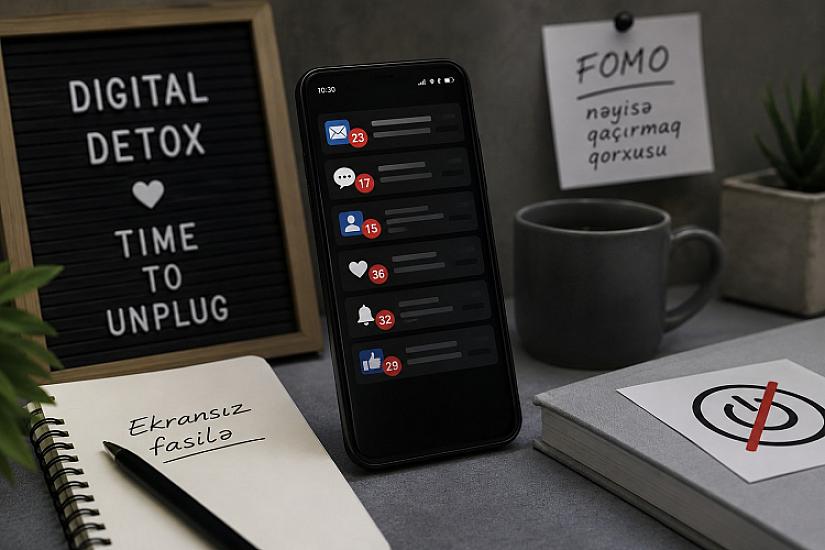
Smartphones, social media, notifications coming to phones without calls, and the constant flow of information have become an integral part of our daily lives. Although technology makes our lives easier, long-term use of phones and staying constantly online has now led to the emergence of a condition called "digital fatigue."
How can one get rid of digital fatigue? What are the main differences between simple fatigue and digital fatigue? How does FOMO (fear of missing out) affect psychological health? Is digital detox really effective?

Speaking to Medianews.az about the topic, psychologist Farida Sharifova stated that in recent years, phones and social media have greatly facilitated our lives, but there is a fact that our brain is not designed to work continuously: "During the day, constant notifications, messages, videos, news, and social media streams tire our brains. Interestingly, people sometimes say: "I haven't done any heavy work, but I feel very tired." One of the reasons could be digital fatigue.
We open our eyes in the morning, the phone is in our hand, throughout the day messages, notifications, social media, news... The brain does not rest even for a moment. Imagine that ten people are talking at the same time in a room and you try to listen to all of them. After a while, how would you feel? Our brain experiences approximately the same during the day.
The first step to overcoming digital fatigue is not to completely put the phone aside. It is more necessary to change usage habits. There is a very simple rule: give yourself short “screen-free breaks” throughout the day. For example, sit without your phone while drinking tea, go for a short walk, or stay away from screens for half an hour before sleeping."
The psychologist noted that there is a difference between simple fatigue and digital fatigue: "After normal fatigue, a person feels better after resting. But in digital fatigue, even if the person is tired, they still cannot put down their phone. It’s as if an excessively open window remains in the brain. As a result, attention decreases, irritability increases, and the person feels scattered."
There is also the issue of FOMO. That is, the feeling of "what if I miss something." I think this feeling exists in many people. Even if the phone is set aside for a few minutes, the person becomes uneasy: "I wonder what they shared? Did I miss something?" This is no longer just curiosity; it can turn into internal tension. Without realizing it, a person begins to compare their own life to the ideal images shared by others.
Regarding digital detox, I think the issue cannot be framed as removing the phone from our lives. Because technology is not our enemy. The problem is that sometimes we forget to give ourselves a break. Sometimes a person just needs silence, not the phone. Even small breaks send the brain the message “I am here too, take a breath.” Because being online all the time does not mean that we are truly living life."
Naile Gasimova,
Medianews.az