
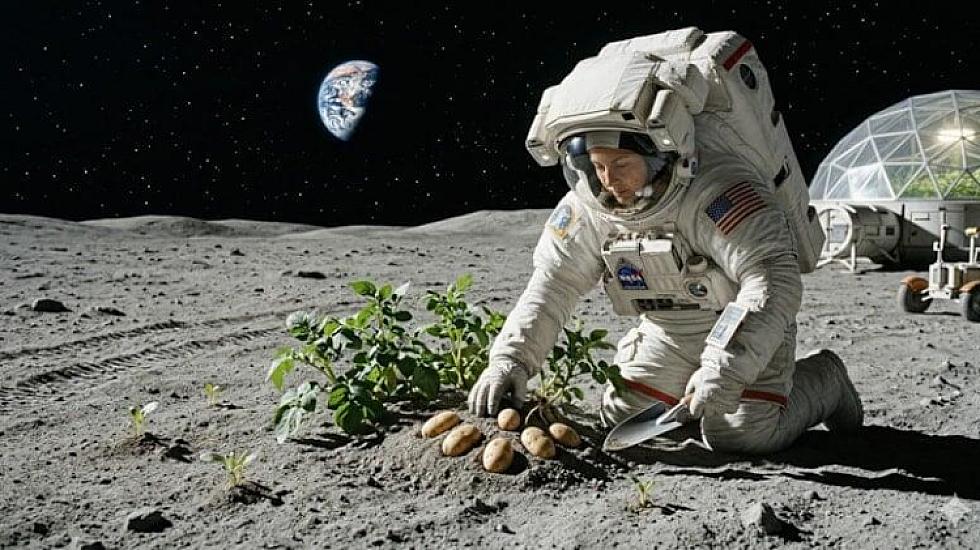
David Hanry, a space biologist at Oregon State University (OSU), and his team have succeeded in producing potatoes by recreating lunar regolith (surface dust) in laboratory conditions. The productivity obtained from the studies shows that if favorable conditions are created, it will be possible to grow potatoes on the lunar surface in the future.
According to Milli.Az, the regolith layer covering the lunar surface has a loose and dusty structure. This surface does not contain the organic materials necessary for plant growth. Scientists have obtained a similar lunar soil sample using a mixture of crushed minerals and volcanic ash. Unfortunately, because this soil lacked organic matter, it was impossible for plants to grow. To solve this problem, the team decided to use worm manure. Research showed that by adding 5% worm manure to the mixture, a suitable environment for potato growth is created.
The experiment lasted about two months. The potatoes grown were harvested, freeze-dried, and ground before analysis. DNA studies showed that the plants activated their stress-related genes. Interestingly, the "moon potatoes" had higher copper and zinc content than traditional potatoes. This indicates a potential risk for human consumption. However, the nutritional value of the plants was similar to that of regular potatoes. Hanry explains this by stating that despite the plants expending additional energy to cope with stress, they were able to maintain their nutritional value.
Jared Long-Fox, a lunar specialist from NASA's Jet Propulsion Laboratory, notes that this work is an important step, but that hazards such as vacuum and radiation present on the Moon have not yet been taken into account. He also emphasizes the importance of replicating experiments on actual lunar soil. It is expected that bringing larger and more diverse lunar samples within the framework of the "Artemis" program will pave the way for such research. Plant biochemist Aymeric Goyer from OSU stresses that their goal is to identify the potato varieties most suitable for the Moon and to develop varieties adapted to the lunar environment through genetic selection in the future.