
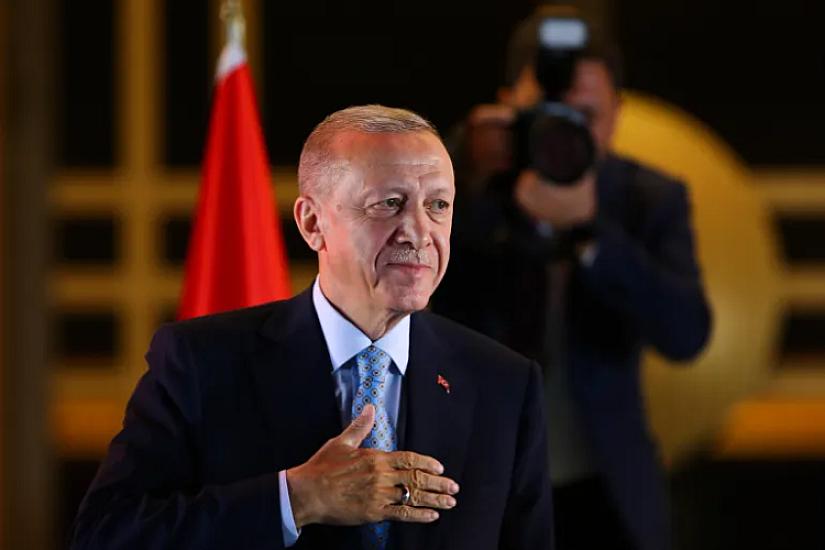
On February 26, Turkey's president Recep Tayyip Erdoğan, who turned 72, has been in politics for 50 years.
Medianews.az reports that Recep Tayyip Erdoğan, born in 1954, graduated from Marmara University with a degree in economics and commerce.
He joined politics in 1976. He was a member of the National Salvation, Welfare, and Virtue parties. From 1994 to 1998, he served as mayor of Istanbul. In 1999, he was imprisoned.
In 2001, he founded the Justice and Development Party. He became prime minister on March 14, 2003, and was elected president on August 10, 2014, June 24, 2018, and May 28, 2023.
After the 2018 election, the president also became the head of government.
Between 2002 and 2023, the Justice and Development Party won 7 parliamentary, 4 municipal, and 3 presidential elections, and achieved its goals in 3 referendums.
The party won the 2002 parliamentary election and formed a single-party government, retaining its ruling status in the 2007 election.
In the June 7, 2015 election, the party gained a partial majority but was unable to form a single-party government, leading to a snap election. After the November 1, 2015 parliamentary election, the Justice and Development Party once again formed a single-party government.
The party also won the municipal elections of 2004, 2009, 2014, and 2019.
Following initiatives by the Justice and Development Party, constitutional reform referendums were held. These reforms established the election of the president by popular vote rather than by parliament, curbed parliamentary governance, and formalized the transition to a presidential system. These changes were supported by a majority in the 2007, 2010, and 2017 votes.
Recep Tayyip Erdoğan, who first received the presidential mandate in 2014, also won the presidential election held jointly with the parliamentary election on June 24, 2018. In the parliamentary election, the Justice and Development Party and its ally—the Nationalist Movement Party—were victorious.
On May 14, 2023, another double election was held. The Justice and Development Party and its allies—the Nationalist Movement Party, the New Welfare Party, the Free Cause Party, and the Democratic Left Party—won the parliamentary election. The presidential election went to a second round, in which Recep Tayyip Erdoğan prevailed on May 28.
In the 2024 municipal elections, the Justice and Development Party experienced its first defeat, with the opposition Republican People's Party gaining the upper hand.
According to the Constitution of Turkey, no one can be elected president more than twice. Since this limit is counted from 2018, Recep Tayyip Erdoğan received the presidential mandate again in 2023.
The Parliament—the 600-member Grand National Assembly of Turkey—has the right to call a snap election with 360 votes. In this case, the double election system will be applied, and Recep Tayyip Erdoğan could once again run for president.
Toğrul Ali,
Medianews.az