Although there are many reasons that make the collapse of Russia inevitable, in my opinion, there are five main factors.
Like the other two empires in history established by the Russian people – Tsarist Russia and the Soviet Union – the Russian Federation is also a militarist state.
The most important factor determining the fate of militarist states is the condition of the army and the attitude of society towards the army.
The disastrous losses of the Russian army in World War I were the main factor that conditioned the collapse of the empire.
The prolonged and exhausting war in Afghanistan ending without result triggered the collapse of the Soviet Union, which was undergoing a deep economic crisis.
Currently, in the more than 4-year-long criminal war against Ukraine, the Russian army has suffered very heavy losses and sustained an incurable wound.
According to the information of the "Mediazona" internet resource as of April 24, the BBC broadcasting corporation together with a group of volunteers was able to identify by name 213,858 casualties in the Russia-Ukraine war. Of course, the list compiled from open sources does not contain the names of all Russian soldiers lost in Ukraine. Russia keeps its losses secret and does not provide information to the public about soldier deaths. Therefore, "Mediazona" notes that those identified account for about half of the deceased military personnel.
This report from "Mediazona" confirms that the Western intelligence reports stating that the number of Russian soldiers killed in the criminal war against Ukraine exceeds 415,000 reflect realities. The catastrophically large loss has led to the Russian army losing its combat capability.
Although the Russian Ministry of Defense and other official bodies do not provide information about the losses, in the age of the internet it is impossible to conceal everything completely. As Russian society becomes informed about the scale of disastrous losses, morale related to the army deepens in society. For all these reasons, even Russian experts themselves claim that Russia’s current situation resembles the situation of Tsarist Russia in the winter of 1916. The army is not capable of winning the war and this is known to society.
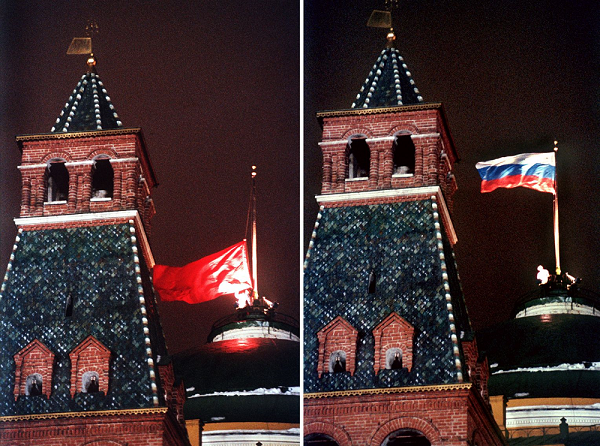
The second factor making Russia's collapse inevitable is the loss of trust in President Vladimir Putin. The loss of trust in Emperor Nicholas II deprived the Tsarist elite of support and resulted in the monarchy’s overthrow. The loss of trust in Mikhail Gorbachev, the first and last president of the Soviet Union, led to the "GKChP coup" (State Committee on the State of Emergency). This created a power crisis and the USSR collapsed.
A similarity between the collapse of Tsarist Russia and the Soviet Union is that the power crisis triggers the state’s collapse.
Now, trust in Putin has been lost within the Russian elite as well, and this situation makes a power crisis inevitable. Once a power crisis emerges, Russia will begin to collapse.
It should also be noted that the existing authoritarian regime in Russia is the weakest among absolutist regimes. Monarchies are justified by divine will, and totalitarian regimes by appealing ideology, and therefore, in the eyes of society, they have more legitimacy than an authoritarian government formed around one person. Although monarchies and totalitarian regimes have mechanisms for the legitimate transfer of power in crisis situations, authoritarian regimes lack such a mechanism.
As German political scientist Johannes Gerschewski, author of "The Two Logics of Autocratic Rule," notes in his work "The Three Pillars of Stability: Legitimation, Repression, and Co-optation in Autocratic Regimes," legitimacy is vitally important for the existence of a regime. Even if repression intensifies, it is impossible to integrate elites into the system through co-optation, i.e., the distribution of resources and privileges.
After declaring that Putin should be tried as a war criminal, Z-blogger Ilya Remeslo was hospitalized in a psychiatric hospital. After his release, he again targeted Putin, calling him the sole cause of all the problems in the country. Remeslo, who had been a long-time propagandist of the regime, confirms through his statements that Putin's authoritarian regime has lost legitimacy and cannot sustain its existence for a long time.
The third condition making Russia's collapse inevitable is the collapse of the economy. As a result of Western sanctions, Russia has been significantly isolated from the global economy. After rapidly integrating into the global economy following the collapse of the Soviet Union, Russia cannot survive long in the current state of isolation. Finally, sanctions are beginning to bear fruit and the Russian economy is collapsing. Although this is a very broad topic, I will try to show the current state of the Russian economy with two statistical data points without tiring readers.
The Leningrad region, one of Russia’s wealthiest subjects, is lacking 8.5 billion rubles in its budget to make payments to participants in the war against Ukraine. Another piece of information is that, as warned by Finance Minister Anton Siluanov, the budget deficits of the regions have reached a terrible scale, reaching 2 trillion rubles. It is clearly seen that budget deficits prevent the state from fulfilling its obligations.
The state's inability to carry out its responsibilities creates the fourth condition making Russia’s collapse inevitable. This is disruption in governance and decentralization. When the state cannot fulfill its obligations, the regions start to act independently to save themselves. The events in the last year of the Soviet Union are a clear example of this.

The fifth condition making Russia's collapse inevitable is unfavorable international relations. Russia’s isolation from international relations is perhaps the foremost of the conditions that make its collapse inevitable. For the last 300 years, Russia has been one of the states determining international relations and sometimes the foremost one. However, now even former provinces sign global projects without needing to consult with Russia. It is the result of isolation from international relations that Russia was unable to maintain its traditional sphere of influence in Syria, and also failed to protect Nicolas Maduro and Seyyed Ali Khamenei from the U.S.
Dayan Francis, editor of Canada's English-language "National Post" newspaper and senior fellow at the "Atlantic Council," mentions in one of her recent articles that Russia is already a dead zone and the collapse of the empire is inevitable.
Khagani Jafarli,
political scientist