
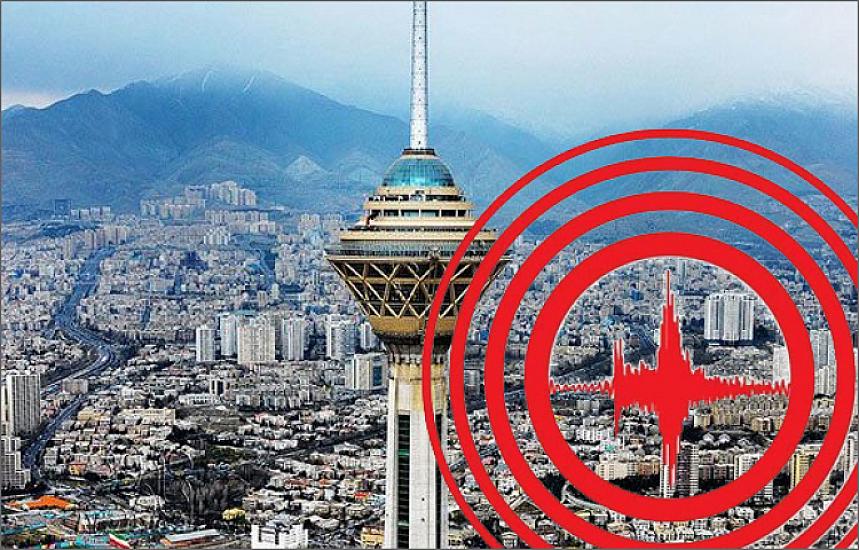
A series of earthquakes in Tehran, the capital of Iran, has caused serious concern in the country.
Medianews.az reports that Iranian seismologists warn that the Mosha fault line near the capital (named after the Mosha village near Tehran, an active fault line extending from the east of the capital along the Alborz mountains) could become active again.
On the evening of May 22, eight successive underground tremors were recorded in Tehran and surrounding areas. The epicenter of the earthquakes was mainly near the city of Pardis. The first tremor occurred at 20:41 local time with a magnitude of 3.4. Later, at 23:46, the main earthquake occurred at a depth of 10 kilometers with a magnitude of 4.6. The tremors continued until morning.
The earthquake was felt not only in Tehran but also in some areas of Karaj, Varamin, Pakdasht, and Mazandaran provinces. During the event, wind blew at a speed of 55 kilometers per hour in the capital, and power outages occurred in some districts.
According to official information, no human casualties or serious destruction were recorded as a result of the earthquakes. Nevertheless, many residents spent the night in the streets and open areas. Tehran's fire department, emergency services, and civil defense forces have been put on high alert.
Data from the Geophysics Institute of Tehran University shows that the region experienced a sequence of "initial tremor – main earthquake – aftershock." All underground tremors occurred at depths of 8-10 kilometers, which made them felt stronger on the surface.
Experts indicate that Tehran and its eastern part along the Alborz mountains are among the most dangerous seismic zones. The main threat source is the Mosha fault line, estimated to be 200-400 kilometers long. This fault line has the potential to cause a destructive earthquake with a magnitude above 7.
According to historical data, in the 19th century, an earthquake of approximately 7.1 magnitude occurred exactly along this fault line, causing major destruction around Damavand, Shemiran, and Tehran. Iranian experts believe that the recent tremors may indicate that the energy accumulated at the Mosha fault line has not been fully released and that tension is still ongoing.
Experts report that near Pardis, the northern Tehran fault line intersects with the Mosha fault line, creating a high-risk zone called a "tectonic knot." In their opinion, the frequent repetition of weak and moderate earthquakes could be a precursor to larger underground tremors in the future.
Densely populated areas and multi-story buildings east of Tehran are considered risk zones. Geologists say the region's composition of soft sediments amplifies the earthquake waves.
Seismologists call on the Iranian authorities to install more modern seismic monitoring systems in the east of the capital, reassess building resilience, and strengthen infrastructure preparedness for emergencies.