
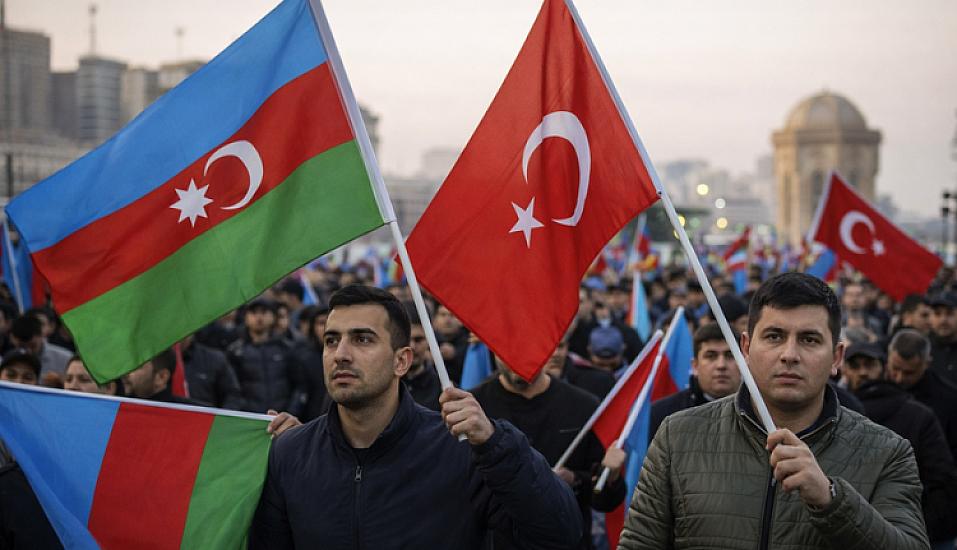
One of the most fundamental questions for Azerbaijan today is this: what is primary for us — religious identity or national identity? In other words, is it more important to be Shia or to be Turk?
The reality of Azerbaijan has already answered this question. History and geopolitics also show that the decisive factor in our geography is not religion, but national identity. Because states and nations build their relations not on ideological slogans but on real interests.
If Shia Islam were the decisive factor, logically Iran, which presents itself as the "leader of the Shia world," would have stood alongside Azerbaijan in the Karabakh war. But the reality was completely opposite. Iran stood with Armenia and against Azerbaijan. This fact showed that religious affinity does not determine political behavior.
On the contrary, Turkey took a clear and principled stance alongside Azerbaijan. The main factor behind this was the shared national identity and strategic proximity.
At this point, one of the most important issues to pay attention to is the situation of Turks living inside Iran. According to various estimates, Turks make up nearly half of Iran's population. Nevertheless, their national and cultural rights are severely restricted. The lack of opportunities for education in their mother tongue, the absence of institutional recognition of national identity, and other restrictions have been topics of discussion for many years.
This situation also draws attention from a historical context perspective. Turks have been one of the main bearers of political power in the Iranian geography for centuries. It is noted that during the rule of various Turkic dynasties, there was a certain tolerant approach to ethnic and religious diversity within the country. However, from the early 20th century, especially from the Pahlavi era onwards, tendencies towards centralization and homogenization in national identity policy have strengthened. After the Islamic Revolution, hopes were not fulfilled, and the situation worsened even more.

In this context, Iran's policies in the region also require special attention. It is frequently emphasized that official Tehran uses religious ideology as a geostrategic tool of influence. Especially concerning Azerbaijan, it is noted that Iran tries to expand its influence through the Shia identity.
On the other hand, various influence mechanisms also undoubtedly exist over Azerbaijani communities living in Georgia and Turkey. It is frequently highlighted that Iran executes this influence through social, religious, and cultural channels and invests serious resources in this direction.
Against this backdrop, one of the criticized points is that Azerbaijan does not always conduct consistent and systematic policies against these influences at the ideological level. Although sometimes the national identity and Turkism line come to the forefront, it is noted that this approach is not continuous.
That is, when relations become tense, the national identity factor activates, but when relations stabilize relatively, this line weakens. Meanwhile, the other side, namely Iran, uses ideological tools more systematically.
Parallel to this, new formats of political coordination are also forming in the region. According to "Middle East Eye," the growing dialogue and cooperation between Turkey, Pakistan, Saudi Arabia, and Egypt draws attention. The fact that these countries are predominantly Sunni adds an additional geopolitical and sectarian measure to their rapprochement.
This is one of the processes carefully monitored by Iran. Because the formation of alternative centers of power in the region could change the existing balance.
In this complex picture, Azerbaijan tries to conduct a balanced policy. Azerbaijan is an ally of Turkey and a strategic partner of Israel. It has also been noted at various levels that Baku played a role in normalizing relations between Ankara and Tel Aviv.
At the same time, social and political dynamics inside Iran are also changing. Various observations show that there is discontent within society, which could be a factor affecting the region in the long term. It is also undeniable that the peoples included in Iran's ethnic structure no longer have significant trust in the mullah regime. This factor could also act as a catalyst accelerating processes.
Against all these factors, the conclusion emerges: Azerbaijan's main priority is a policy built on national interests and national identity. Religious identity cannot replace this policy.
In this regard, the statement by Ilham Aliyev, "The Turkic world is our family. We have no other family," expresses a strategic approach. This approach is not accidental; it is based on historical and geopolitical realities and leads us toward Turan.
In my opinion, the choice facing Azerbaijan is not ideological but strategic. This choice must be determined not by emotions but by a correct assessment of realities. The processes taking place in the region show that a policy based on national identity and national interests is more sustainable and effective.
Elbeyi Hasanli, Zurich