
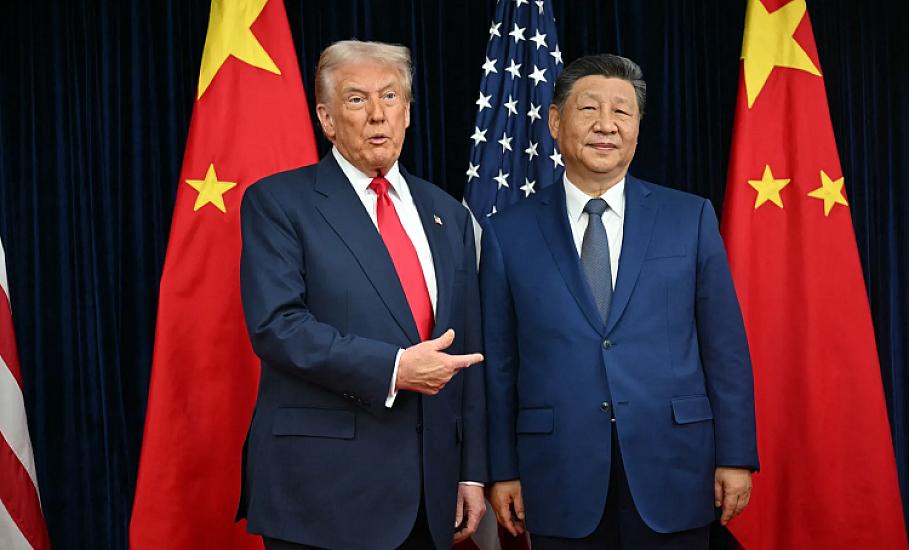
An article titled “Trump gives an ultimatum to Latin American countries: either me or Jinping” has been published on the website of the US publication "Politico".
According to Medianews.az, the article states that US President Donald Trump is effectively issuing an ultimatum to Latin American countries: you must side either with Washington or Beijing.
The newspaper emphasizes that the purpose of the new course formulated at the White House is to weaken China's influence in the Western Hemisphere, and if possible, to completely squeeze out and eliminate it: “Sources and analysts in Washington say the main goal behind Trump's hard line in the Western Hemisphere is to prevent the economic and geopolitical expansion of the People's Republic of China, led by Xi Jinping. According to the White House administration's approach, unless the US restores dominance in the region it considers its ‘backyard,’ it can neither safeguard its national security nor compete with Beijing in the Indo-Pacific region.
The White House, referring to Trump's national security strategy, stresses the reapplication of the classic ‘Monroe Doctrine.’ According to the official explanation, the aim is to restore US supremacy in the Western Hemisphere, squeeze rivals, and control migration and drug trafficking. Although China is not explicitly named, the message's target is clear.”
“Politico” writes that figures defending a tough line against China dominate Trump’s foreign policy team: “Vice President James David Wences, Secretary of State Marco Rubio, as well as Pentagon officials, consider Beijing the main strategic threat to the US. Defense Secretary Pete Hegseth has openly called China's military power a risk to global stability.
The consensus forming within the administration is: ‘To defend the homeland, one must dominate the hemisphere.’”
One of the most notable moves in Washington’s policy was the arrest of Venezuelan leader Nicolas Maduro. The US operation is viewed not only as a regional political change but also as a blow to China’s energy interests in the region. Beijing was one of the main buyers of Venezuelan oil and a key economic partner.
The White House administration is also increasing pressure on Cuba, adopting tough rhetoric with Panama, and openly expressing dissatisfaction in relations with Brazil. The Panama issue is particularly symbolic: it was the first Latin American country to join China’s “Belt and Road” initiative.
Washington views China’s economic influence in Latin America as a threat to national security. In 2025, trade turnover between Beijing and Latin America is expected to reach $565 billion. For comparison, the trade turnover between the US and Latin America is $346 billion.
Beijing has involved 22 out of 33 Latin American and Caribbean countries in the “Belt and Road” infrastructure projects. Projects such as hydropower developments in Ecuador, the construction of the Bogota metro, and the gigantic Chancay port in Peru serve to strengthen China’s position in the region.
The US State Department warns that Chinese companies, expanding through “unfair trade practices” and government subsidies, could make regional countries dependent.”
The article states that Donald Trump plans to bring together Latin American leaders in Miami on March 7: “This meeting will take place shortly before the summit with Xi Jinping in Beijing. Washington's goal is to convince the regional countries to reduce their economic ties with China.
However, experts warn: if the US does not offer a real and long-term alternative, this ultimatum could backfire. China has great demand for the region's raw materials – soy, iron ore, beef – and the Asian market currently is the fastest growing market in the world.
According to former diplomats, although Trump’s harsh rhetoric may create a short-term pressure effect, in the long term it could increase anti-American sentiment in Latin American capitals and strengthen Beijing’s hand even more.
Thus, the message of the Trump administration is clear: China’s space in the Western Hemisphere is shrinking. The choice is before the Latin American countries – Washington’s geopolitical umbrella or Beijing’s economic appeal.”