
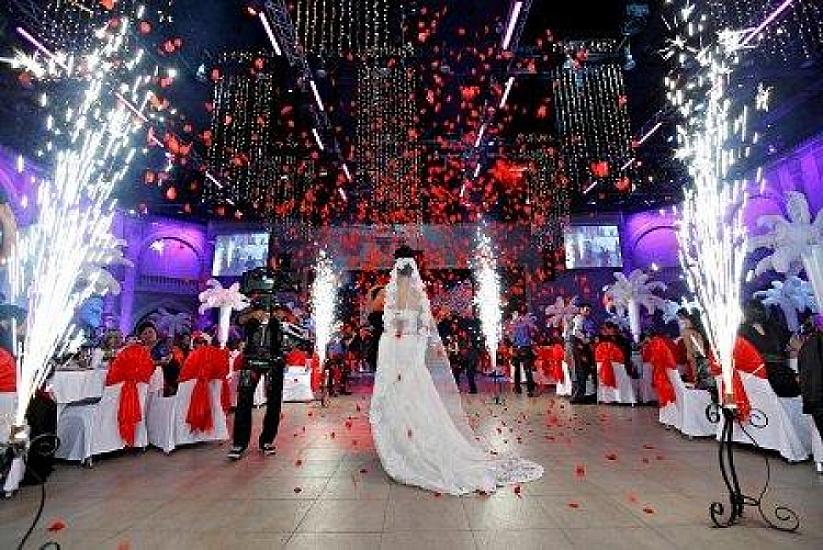
Clarinet player Hüseyn Məhəmmədoğlu has said that now at weddings, the groom and bride do not want "Vağzalı." He noted that mugham performers also facilitate this.
"For several weddings now, we have not performed 'Vağzalı.' Certain songs are selected. Foreign songs of unknown origin come in with the groom and bride during the performance of mugham singers. But 'Vağzalı' must not be forgotten. Mugham was like this once. First Lady Mehriban Əliyeva revived mugham and introduced it to the world," the artist said.
According to him, mugham performers enable people to forget "Vağzalı." "They sing beautifully, performances are excellent. But the place of 'Vağzalı' is special. I kindly ask that at least for 15 minutes at the beginning of a wedding, 'Vağzalı' be played," the clarinet player added.
Could such a trend become widespread? So what about our customs and traditions?
Medianews.az reports that Honored Artist, mugham performer Elnarə Abdullayeva spoke to Musavat.com about the matter. The singer responded to the comments as follows: "It is the first time I hear about this. 'Vağzalı' is played at the weddings I participate in. I can't precisely say what music is performed at other weddings. Whether it's about 'Vağzalı' or foreign music, it is not my place to interfere with someone's choice. The main thing is that people be happy. Everyone decides for themselves which music to enter the wedding with and which one to conclude with. This is entirely a personal choice and external interference is inappropriate. If I personally said it should not be so, would this change anything? Certainly not.
As for mugham performers playing foreign music at weddings, frankly, I have not encountered that. Even if such cases exist, it is also everyone's own choice. I myself have performed foreign music—for example, a French song—but not at the moment the groom and bride enter the wedding. If there is a specific mugham performer in question and their name is known, it can be mentioned. In general, if mugham performers turn to foreign music, this can be regarded as a sign of development in a certain sense. What's wrong with that? The main thing is that this process does not go against our national values. May God not take this development from us. Everything is more valuable when it proceeds naturally and beautifully."
The chairman of the New Writers and Artists Public Union, writer-culturologist Aydın Xan Əbilov noted that the Azerbaijani wedding is a living institution of our national culture and people and has always been open to innovation: "Once, in the 1960s, although we did not want to accept the reforms in Azerbaijani weddings, those changes gave us today's wedding format. That is, previously men's and women's weddings, girls' and boys' gatherings were held separately. Later, changes occurred in this system. There was even a period when men could not enter women's weddings (mağar toy) and women could not enter men's weddings, which caused dissatisfaction and even disputes to some extent.
In recent years, mağar weddings have almost disappeared and most wedding ceremonies are held in a single gathering. Although women's and men's weddings were separate before, now they have been merged and in banquets, restaurants, we witness a hybrid national wedding model, which is a combined form of henna nights, dress cutting, girls’ and boys’ weddings. Sometimes the concept of a wedding has a broader meaning and is organized in the form of large gatherings or special banquet formats. In my opinion, this approach is more appropriate. Because Baku, as the capital, unites about half of Azerbaijan's population. Most of the population lives in the Absheron Peninsula, especially in Baku. If everyone organizes separate tents or mağar weddings or organizes ceremonies individually, this can cause serious chaos."
The expert added that currently more hybrid and interesting wedding forms are observed: "Even those who hold weddings broadcast the ceremony live so that their relatives living abroad who cannot attend the wedding can also share in this joy. Regarding the issue of music played at weddings, earlier we often criticized weddings for excessive extravagance both in music and feasts. But we forget that a wedding usually happens once in a person's life, and as Azerbaijanis, we love hospitality and abundance of feasts. It is natural for us to spend some expenses to showcase this at our own weddings, provided it does not go to excess.
Now, more attention is paid to wedding music. Yet wedding melodies and dances are an inseparable part of Azerbaijani culture. It can even be said that national music and arts have developed further especially in the wedding environment. A wedding is also a kind of creative business sector—there are fees, people enjoy themselves and also earn income. Because of this, wedding music does not remain static; it constantly changes, renews, and goes through certain reforms.
Yes, our ears and taste are very accustomed to the music of 'Vağzalı,' but it is not the only dominant music. If we do not want to see the same scenario and the same music at all weddings, we should not make not playing 'Vağzalı' or the groom and bride entering the ceremony with other music such a big problem or bring it into public debate. People have different opinions. Nowadays, in many cases, people marry not only within their nation but form multicultural families, marry representatives of different peoples. An Azerbaijani girl or boy may marry someone foreign and even different in terms of religion. In such cases, it would not be right to demand that they enter the gathering definitely to the sounds of 'Vağzalı.' Of course, if there is 'Vağzalı,' it appears more national and familiar, but its absence is not a tragedy. The groom and bride can also enter the gathering to other music.
Recently, weddings enriched with songs and dances, more theatrical ones have been seen. Weddings scripted by special organizers have become fashionable. In such ceremonies, sometimes we see that according to the script, the groom and bride enter the gathering to the sounds of the Azerbaijani anthem or the overture of "Koroglu." There are also weddings related to martyr families and veterans, and in such cases, instead of the solemn 'Vağzalı,' more fighting-spirited or sorrowful music is played."
Aydın Xan Əbilov finally emphasized that intervening in people's personal choices or opening big discussions around the question "why not 'Vağzalı'?" is not quite appropriate: "Everyone chooses according to their taste, worldview, and lifestyle, and it would be a better approach to respect these choices."